Scale models have supported UK defence procurement for decades, giving MOD and DE&S teams a tangible way to test assumptions, clarify requirements and reduce risk before committing billions of pounds to complex equipment programmes. In an environment where the National Audit Office (NAO) has repeatedly identified cost growth, schedule delays and affordability gaps across major defence projects, physical models offer a practical, low-cost tool to strengthen business cases and improve stakeholder alignment at every stage of the acquisition lifecycle.
Defence Equipment & Support (DE&S), the MOD’s procurement arm headquartered at Abbey Wood, Bristol, is responsible for delivering equipment and support services to the Royal Navy, British Army and Royal Air Force. The programmes it manages are among the most technically complex in government — and the stakes are high. Getting requirements wrong, underestimating complexity or failing to engage stakeholders early can add years of delay and billions in cost growth. Scale models help procurement teams address precisely these challenges.
What Do We Mean by “Defence Procurement” in the UK?
Defence procurement is the end-to-end process by which the Ministry of Defence identifies, acquires, supports and eventually disposes of military equipment and capability. In the UK, this defence procurement process follows the CADMID lifecycle — Concept, Assessment, Demonstration, Manufacture, In-Service and Disposal — which is the MOD’s established framework for acquiring equipment capability. The main investment decision sits between the Assessment and Demonstration phases, where a costed, risk-tested business case must pass scrutiny before significant expenditure is authorised.
DE&S leads on commercial negotiations and day-to-day supplier relationships, while Commands (Army, Navy, Air and Strategic Command) are accountable for programme delivery. In 2024, the MOD adopted the Integrated Procurement Model, designed to streamline CADMID and deliver working capability into service within five years. The process is overseen through Investment Approvals Committee (IAC) scrutiny, where business cases must demonstrate value for money.
How Are Scale Models Used Across the Defence Procurement Lifecycle?
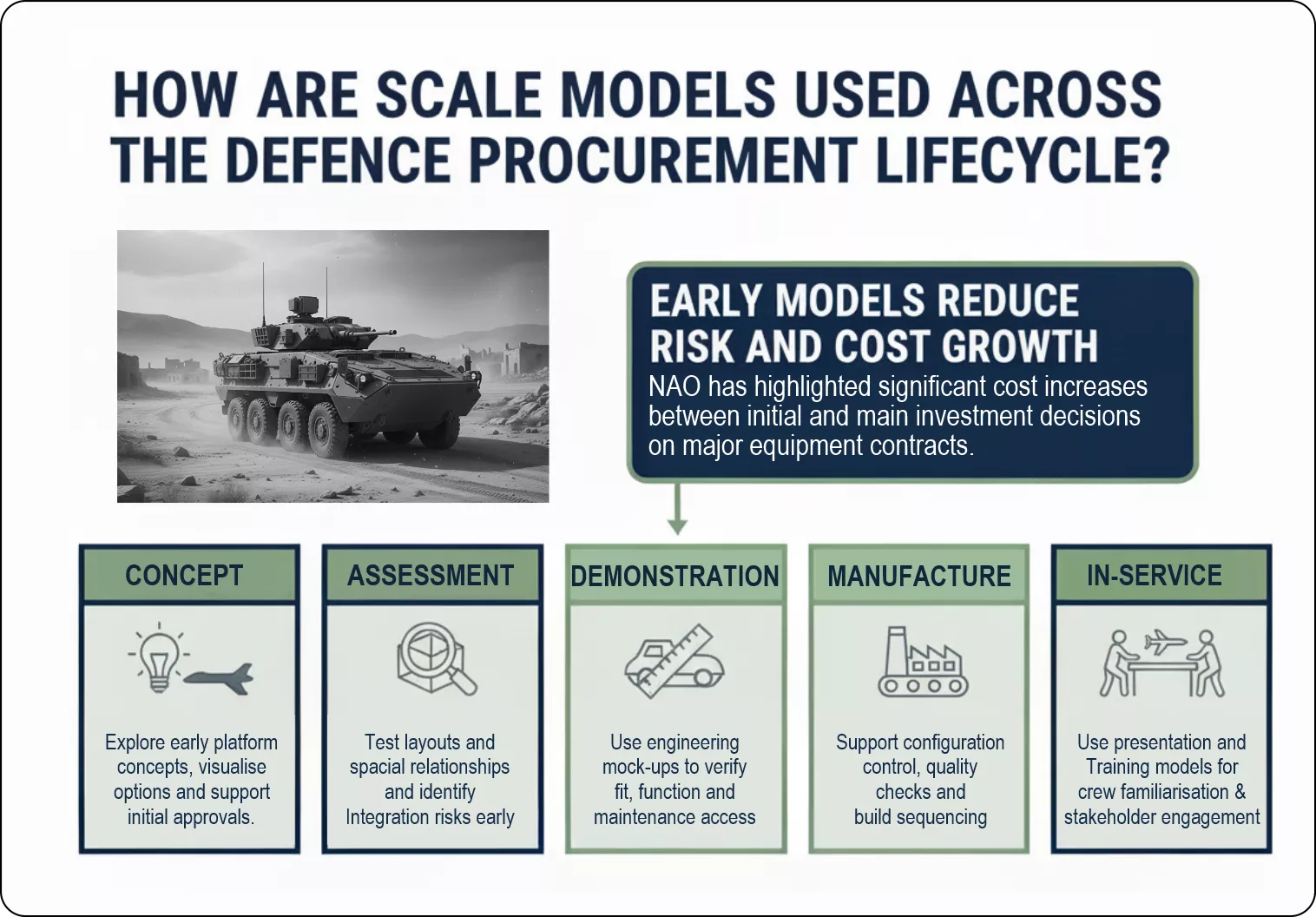
In relation to defence procurement, scale models serve distinct purposes at each CADMID phase, from early concept exploration through to in-service training. At the Concept and Assessment stages, physical models help teams visualise proposed platforms, test spatial relationships and identify integration challenges before detailed design work begins. During Demonstration and Manufacture, engineering mock-ups allow teams to verify layouts, check component fit and rehearse maintenance procedures. At the In-Service stage, presentation and training models support crew familiarisation, operational planning and public engagement.
This lifecycle alignment matters because the NAO’s 2021 report on major equipment contracts found that the forecast cost of nine out of twelve programmes examined increased between the initial business case and the main investment decision — in three cases by more than 59%. Much of this cost growth stemmed from the MOD and its suppliers underestimating the scope and technical complexity of projects. Physical models introduced early in the lifecycle give procurement teams a shared reference point that exposes spatial, integration and interface risks before they become expensive problems.
How Do Scale Models Reduce Risk in Complex Defence Procurement Projects?
Scale models reduce procurement risk by making abstract requirements tangible, enabling teams to identify design conflicts, spatial constraints and integration issues before they reach the contract stage. The NAO has found that recurring causes of delays and cost increases include setting over-optimistic schedules, supplier underperformance and the MOD underestimating project scope and complexity. Across 13 programmes examined, cumulative forecast net delays totalled 254 months.
Consider a naval vessel procurement where compartment layouts, equipment routing and access for maintenance must all be validated. A scale model of the ship’s internal arrangement allows engineers, operators and DE&S project teams to walk through spatial relationships in three dimensions — identifying clashes or oversights that two-dimensional drawings may obscure. Similarly, for a vehicle integration programme, a physical mock-up can reveal whether proposed equipment fits within the platform envelope and whether maintenance crews can reach critical components. These are risks that, if discovered late, trigger costly redesign and contract renegotiation.
The NAO specifically noted that the MOD has experienced difficulties when attempting to integrate Government Furnished Assets with supplier work — a scenario where physical models can expose interface problems before contracts are let.

How Do Models Help DE&S Demonstrate Value for Money and Assurance?
Physical models strengthen the evidence base for business cases presented to the Investment Approvals Committee, supporting demonstrations of value for money and robust risk management. The NAO found that the MOD does not rigorously review whether it is continuing to secure value for money across the lifecycle of its projects as costs and schedules change. Business cases must justify the chosen contracting approach, yet affordability and limited contracting solutions frequently determine how value for money is defined.
Scale models provide a concrete, visual component to these business cases. When DE&S teams present to the IAC or senior stakeholders, a model offers immediate clarity on what is being procured, how components relate to one another and where technical risks lie. This supports more informed approval decisions and reduces the likelihood of requirements changes after contract award — a problem the NAO highlighted on the Ajax armoured vehicle programme, where changed requirements after contract let made it more difficult for suppliers to achieve cost and schedule milestones.
The NAO’s Equipment Plan report for 2023–2033 found the plan to be unaffordable by £16.9 billion. In this fiscal environment, any tool that reduces the risk of costly rework or requirement drift contributes directly to better value for money.
What Types of Scale Models Support MOD/DE&S Procurement Teams?
Different procurement challenges call for different model types. Defence Models UK produces a range of models tailored to MOD and DE&S requirements:
PRESENTATION MODELS
High-quality replicas used in business case presentations, stakeholder briefings and ministerial engagements to communicate platform design and capability clearly.
ENGINEERING MOCK-UPS
Functional models built to validate layouts, spatial relationships, equipment fit and maintenance access during the Assessment and Demonstration phases.
TRAINING AIDS
Detailed replicas used for crew familiarisation, operational planning and instructional purposes during the In-Service phase.
CUTWAYS & CROSS-SECTION MODELS
Models that reveal internal structures, systems routing and compartment arrangements, particularly valuable for naval and aerospace platforms.
DISPLAY MODELS
Replicas used at defence exhibitions, Parliamentary briefings and public engagement events to communicate programme scope and progress.
These complement — but do not replace — digital tools such as CAD simulations and digital twins. Physical models offer a unique advantage in multi-stakeholder settings where not all participants are trained in interpreting digital environments, and where the ability to physically point, rotate and discuss a three-dimensional object accelerates consensus.
When Is the Best Time to Use Scale Models in Defence Procurement?
The greatest return on investment comes from introducing models at the Concept and Assessment stages of CADMID, before the main investment decision. This is when requirements are being defined, options are being compared and business cases are being built. The NAO found that cost increases were most significant before contracts were let, indicating that the pre-contract period is where requirements clarity delivers the highest value.
However, models also serve important functions later in the lifecycle:
- During Demonstration: Validating that the proposed design meets operational requirements and that integration challenges have been addressed.
- During Manufacture: Providing reference models for quality assurance and configuration management.
- During In-Service: Supporting training, operational planning and capability evolution discussions.
The key principle is that models should be introduced before decisions become irreversible. As the NAO has noted, programme teams should demonstrate to the Investment Approvals Committee how they have drawn on all available tools — including lessons from comparable programmes — to reduce risk.
How Can Industry Suppliers Use Models to Improve Collaboration with MOD/DE&S?
Defence industry bid and capture teams can use scale models to differentiate their proposals, demonstrate technical understanding and build confidence with MOD/DE&S evaluators. The NAO found that the MOD relies on a limited specialist supplier base, with some 44% of its £26.6 billion procurement expenditure going to just 10 major providers. In this environment, suppliers that communicate their solutions clearly and demonstrate mature risk management gain a competitive advantage.
A well-executed physical model included in a bid presentation signals investment in the programme and gives evaluators a tangible reference point when assessing technical proposals. Models can also support joint working between MOD/DE&S and industry during the Assessment phase, where the Department’s Strategic Partnering Programme and Category Management initiatives aim to embed commercial good practice.
For further insight into how scale models support UK defence applications, see the Defence Models UK guide to defence model applications.
Important Considerations for Scale Models in Defence Procurement
Scale models are complementary tools. They do not replace formal trials, simulation, testing and evaluation, or the analytical rigour required in MOD business cases. Their value lies in making complex information accessible, exposing risks early and supporting the human dimensions of procurement — stakeholder alignment, decision confidence and requirements clarity.
In a defence procurement landscape where the NAO’s most recent overview found MOD spent £52.7 billion on running costs in 2024–25 and continues to face affordability pressures, tools that reduce the risk of rework, renegotiation and delay deserve serious consideration.
Author Bio
Defence Models UK is a UK-based specialist manufacturer of defence, aerospace and government presentation, display and training models. For over six decades, DMUK has supported the Ministry of Defence (MOD), Defence Equipment & Support (DE&S), prime contractors and defence SMEs with models that provide risk-reduction, requirements clarity and stakeholder alignment in complex defence procurement programmes. Visit defencemodels.co.uk
FAQs
How do scale models support MOD defence procurement approvals?
Scale models provide a tangible, three-dimensional representation of proposed platforms and systems, giving Investment Approvals Committee members and senior stakeholders a clear visual reference when reviewing business cases. This supports more informed approval decisions and helps ensure requirements are fully understood before significant expenditure is authorised.
Do scale models replace formal trials in defence procurement?
No. Scale models complement — but do not replace — formal trials, simulation and testing. They serve as communication, risk-identification and requirements-clarification tools. Formal trials and testing remain essential components of the CADMID lifecycle for validating operational performance and safety.
How do models help address NAO-identified procurement risks?
The NAO has repeatedly found that cost growth and delays stem from underestimating project scope and complexity, poor requirements definition and weak stakeholder engagement. Physical models directly address these risks by making requirements tangible, exposing integration challenges early and facilitating multi-stakeholder discussion before contracts are let.
At what CADMID stage are scale models most valuable?
Models deliver the greatest value at the Concept and Assessment stages, before the main investment decision, when requirements are still being defined. However, they also support Demonstration, Manufacture and In-Service activities including training, configuration management and capability evolution.
Can defence industry suppliers use scale models in bid proposals?
Yes. Suppliers use presentation and engineering models to demonstrate technical understanding, communicate design intent and differentiate their proposals during competitive and non-competitive procurements. Models build evaluator confidence and support joint working during the Assessment phase.
References for Defence Procurement
- Defence Equipment & Support (DE&S) – official UK Government organisation page:
https://www.gov.uk/government/organisations/defence-equipment-and-support - NAO – The Equipment Plan 2023 to 2033 (report):
https://www.nao.org.uk/reports/equipment-plan-2023-to-2033/ - NAO – The Equipment Plan 2023–2033 (full PDF):
https://www.nao.org.uk/wp-content/uploads/2023/12/The-Equipment-Plan-20232033.pdf - NAO – Improving the Performance of Major Equipment Contracts (full report PDF):
https://www.nao.org.uk/wp-content/uploads/2021/06/Improving-the-performance-of-major-equipment-contracts.pdf - NAO – Improving the Performance of Major Equipment Contracts (overview/HTML):
https://www.nao.org.uk/reports/improving-the-performance-of-major-equipment-contracts/ - NAO – The Equipment Plan 2023 to 2033 (press release / summary):
https://www.wired-gov.net/wg/news.nsf/articles/The+Equipment+Plan+2023+to+2033+05122023141500 - NAO – Improving the performance of major equipment contracts (press release / summary):
https://www.wired-gov.net/wg/news.nsf/articles/Improving+the+performance+of+major+equipment+contracts+24062021161500 - MOD – Sustainable Circular Economics for Defence concept note (includes CADMID/T lifecycle context):
https://www.gov.uk/government/publications/sustainable-circular-economics-for-defence-concept-note/sustainable-circular-economics-for-defence-concept-note - Centre for British Progress – Fixing UK Defence Procurement (Integrated Procurement Model context):
https://britishprogress.org/reports/fixing-uk-defence-procurement - NAO – Ministry of Defence 2024–25 Overview (departmental overview and spending context):
https://www.nao.org.uk/overviews/ministry-of-defence-2024-25/ - DE&S – Corporate site (role and narrative on acquisition and support):
https://des.mod.uk - DE&S – “About us” page (responsibilities and scope):
https://www.gov.uk/government/organisations/defence-equipment-and-support/about - DE&S – Framework Document (governance, role and status as bespoke trading entity – PDF):
https://assets.publishing.service.gov.uk/media/5a7eb131e5274a2e8ab4796f/20140513-des-framework-document-v1-May-2014.pdf - UK Government Investments – Defence Equipment & Support shareholder role (budget and scope context):
https://www.ukgi.org.uk/workcs/defence-equipment-support/ - Defence Models UK – About DMUK:
https://defencemodels.co.uk/about-dmuk/ - Defence Models UK – Capabilities:
https://defencemodels.co.uk/capabilities/ - Defence Models UK – How Scale Replica Models Are Used in UK Defence:
https://defencemodels.co.uk/how-scale-replica-models-are-used-uk-defence/
#DefenceProcurement #MOD #DES #ScaleModels #ProcurementRisk #ValueForMoney #DefenceIndustry #CapabilityIntegration #CADMID #DefenceModelsUK #UKDefence #MilitaryModels #DefenceAcquisition #NAO #EquipmentPlan #StakeholderEngagement #RequirementsClarity #BusinessCaseSupport #DefenceEngineering #ModelMaking