Last Updated: May 2026 | Published by Defence Models UK – Specialist Precision Scale Model Makers for the Defence & Aerospace Sector
TL;DR:
The UK’s 2025 Defence Industrial Strategy commits to increasing MOD spending with SMEs by £2.5 billion by May 2028 – the biggest opening of the defence supply chain in a generation. But more opportunity means more competition, and procurement panels make decisions quickly. This article introduces Defence Models UK’s Three-Gate Framework: the three specific moments in an SME’s procurement journey where a precision physical scale model delivers a measurable competitive advantage. If you have a procurement milestone coming up, read this before your next meeting.
Introduction
The UK is in the middle of a defence spending surge not seen since the Cold War. Core military spending stands at £60.2 billion for 2024/25, rising to a projected £73.5 billion by 2028/29. The 2025 Defence Industrial Strategy has restructured how that money reaches the supply chain – and for the first time in decades, there is a genuine, funded, government-backed effort to get significantly more of it to UK SMEs.
That is a substantial opportunity. But a larger door does not make entry easier – it means more companies competing for the same contracts, in faster procurement cycles, in front of decision-makers who have shorter windows to assess each supplier. For UK defence SMEs, the question is not simply whether the opportunity exists. It is whether your company can communicate its capability clearly enough – to a mixed, often non-technical audience, in a room where you may have one meeting to make your case.
This is where a precision physical scale model changes the outcome.
What Has Changed Under the 2025 Defence Industrial Strategy?
The UK’s Defence Industrial Strategy, published in September 2025, is the most significant restructuring of the defence supply chain in a generation. For SMEs specifically, three changes are directly relevant.
The SME spending target. The MOD has formally committed to increasing its direct spending with SMEs by £2.5 billion by May 2028. This is a hard target, publicly stated in the published strategy document – not aspirational language. To give context: in 2024/25, MOD direct spending with SMEs was approximately £1.2 billion, representing just 5% of total procurement spend – well below the Central Government average of 11%. The uplift represents a doubling of SME-accessible spend within three years.
Three procurement buying lanes. The new segmented procurement model ends the one-size-fits-all procurement path and replaces it with three distinct routes, each with faster timelines than before:
- Major platforms lane (ships, aircraft, armoured vehicles): long-term partnerships, with first main contracts agreed in approximately two years rather than after a protracted design phase
- Modular upgrades lane (sensors, weapons, software, sub-systems): competed on roughly annual cycles using common standards and plug-and-play designs
- Rapid commercial exploitation lane (fast commercial tech purchases): completed in three months using dedicated fast-lane funding
Earlier industry engagement. The MOD is moving away from rigid upfront specifications toward industry engagement through Requests for Information and industry days before tenders are released – giving SMEs the opportunity to shape requirements from the outset, not merely respond to them.
The result is a procurement environment that is simultaneously more accessible and more competitive than at any point in recent history. For SMEs that have not previously engaged with MOD procurement, or those scaling up their defence presence, the ability to communicate capability confidently and clearly is now a core commercial skill.
The Communication Problem Every Defence SME Faces
Defence procurement panels are not homogeneous audiences. A typical review panel for a mid-tier contract might include a programme manager from Defence Equipment & Support (DE&S), a military capability officer, a commercial contracts lead, a technical specialist, and a senior sponsor with limited technical background. They are reviewing multiple competing suppliers, often on the same day.
A capability described through slides, documents, and technical specifications reads differently to each member of that panel. The technical specialist absorbs it one way. The commercial lead reads for risk. The senior sponsor, whose decision may carry the most weight, interprets it through a lens of confidence and credibility – and that lens is fundamentally visual and tactile before it is analytical.
This is the translation gap. Your capability may be genuinely superior. But if it cannot be understood, at a glance, by every person in that room simultaneously, it does not fully land.
A physical scale model solves the translation gap. It communicates instantly across all audience types. It demonstrates that your company understands the system well enough to reproduce it. It creates a focal point around which technical discussion can happen naturally. And in a competitive down-select, it signals something slides cannot: that you take this seriously.
The Three-Gate Framework: Where Scale Models Win Contracts
Defence Models UK’s Three-Gate Framework identifies the three specific moments in an SME’s procurement journey where a physical scale model delivers maximum competitive advantage. These are not theoretical – they reflect over 60 years of producing precision models for MoD, the UK armed forces, and defence prime contractors across every domain.
Gate 1 – The Concept Gate
What it is: Your first substantive meeting with a programme manager, capability officer, or prime contractor business development team. This may be an MOD industry day, a concept review, or a direct introduction through a framework event. You typically have 30–45 minutes.
The challenge: At this stage, procurement contacts are assessing whether your capability is worth pursuing. They may see six to twelve suppliers in a day. Your goal is not to close a contract – it is to be remembered and shortlisted for the next conversation.
How a scale model helps: A physical model of your system, platform integration, or component on the table transforms the meeting from a presentation into a demonstration. It creates immediate understanding, generates substantive questions, and makes your company memorable. Defence Models UK clients consistently report that model-led first meetings result in longer, more substantive conversations and a higher rate of follow-up engagement.
Gate 2 – The Exhibition Gate
What it is: Your stand at DSEI, Farnborough Airshow, or a specialist sector exhibition. DSEI 2027 takes place at ExCeL London from 7–10 September 2027. With approximately 30,000 attendees and hundreds of exhibitors, the stand experience is everything.
The challenge: Procurement officials and prime contractor BD teams walk a show floor where every exhibitor is competing for two minutes of attention. Screen-based displays, roll-up banners, and brochures are identical across every stand. You have approximately five seconds to give someone a reason to stop.
How a scale model helps: A precision scale model on your stand stops people. It does not require a pitch. It communicates your capability before a word is spoken, invites handling and discussion, and provides a natural focal point for the conversations that turn into qualified leads. For an SME attending DSEI for the first time, a scale model is the single most effective investment in stand performance available.
Gate 3 – The Bid Gate
What it is: Your formal bid presentation or competitive down-select. You are now in the final two or three. The technical evaluation is largely done. What remains is the human judgement call – which supplier gives this panel the most confidence?
The challenge: At this stage, all remaining suppliers are technically credible. The decision comes down to professionalism, clarity, and the impression of delivery confidence. A panel that has seen dozens of bids recognises, immediately, when a company has invested in communicating its capability seriously.
How a scale model helps: A precision scale model at the bid presentation table communicates readiness and seriousness before a single slide is shown. It makes the proposed system physically present in the room. It gives panel members something to reference throughout the presentation, and something to remember after you have left. In a straight competition between an equally capable supplier with slides and one with a precision model, the model wins.

Three Practical Scenarios
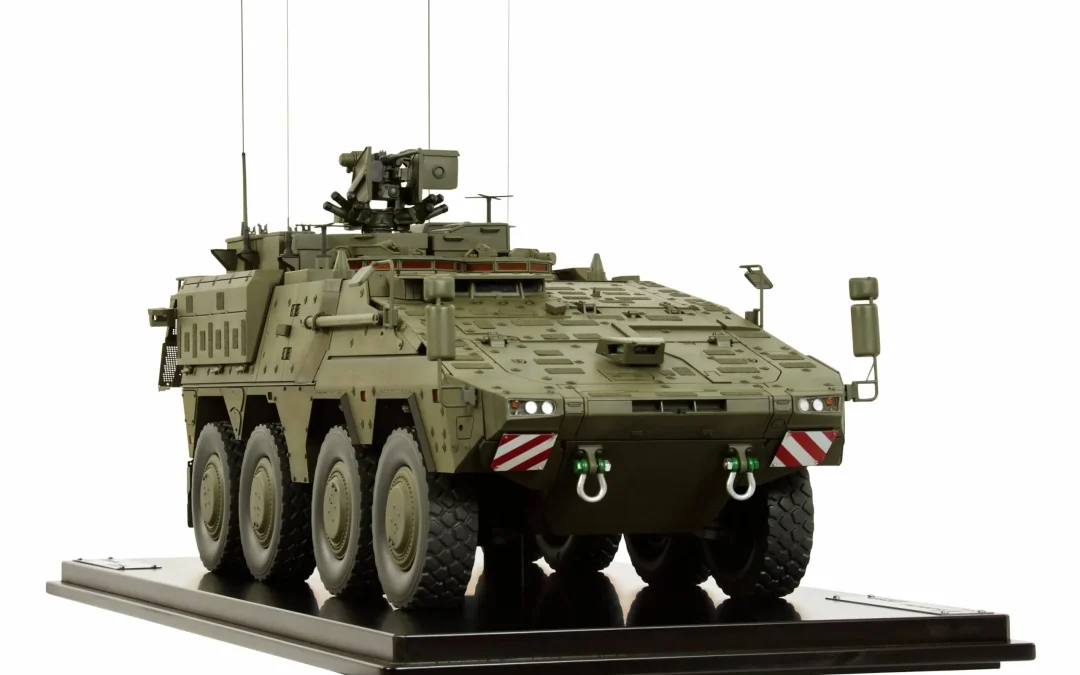
Scenario A: Vehicle protection systems SME, DE&S concept review. An SME developing a modular active protection system for armoured vehicles is invited to a DE&S concept review as part of a market engagement exercise. Twelve companies are attending across two days. They arrive with a 1:10 scale model of their proposed system mounted on a representative vehicle hull section. Every other company presents slides. The model generates 25 minutes of substantive technical discussion in a 30-minute slot, the DE&S programme manager requests a follow-up visit, and the company is placed on the assessment shortlist.
Scenario B: Sensor technology SME, DSEI 2027 stand. An SME with an advanced maritime surveillance sensor has a 6m² stand at DSEI 2027. Their model – a 1:35 scale representation of their sensor array integrated onto a Type 31 frigate superstructure – sits on the stand counter. Three senior Royal Navy procurement contacts stop independently within the first two hours, each initiating a conversation that leads to a formal briefing request. Two result in procurement introductions with DE&S programme staff.
Scenario C: Naval systems SME, competitive bid presentation. An SME is in the final two for a significant modular upgrade contract for a surface vessel programme. The competing supplier has more prior MOD experience. The SME presents with a precision 1:50 scale model of their proposed integration on the table throughout the panel presentation. The panel lead later comments – informally – that the model “made the whole thing concrete.” The contract goes to the SME.

How to Commission a Scale Model as a UK Defence SME
The process is straightforward, but starting early is essential.
Step 1 – Define your procurement milestone and timeline. Which Gate are you preparing for? What is the date of your concept review, exhibition, or bid presentation? Work backwards from that date to establish your commissioning window.
Step 2 – Brief Defence Models UK. Contact DMUK to describe your requirement – the system, the scale, the level of detail needed, and the end use. All initial discussions take place under confidentiality. No detailed design data is required at this stage.
Step 3 – Agree specification and sign confidentiality agreement. DMUK will produce a project specification and timeline. A formal NDA or confidentiality agreement is signed before any sensitive design data is shared. DMUK’s confidentiality protocols are appropriate for commercially sensitive and pre-classified design information.
Step 4 – Review and approve. Depending on complexity, one or more review stages allow you to confirm accuracy before final production.
Step 5 – Take delivery and prepare. Your model is delivered ahead of your procurement milestone, ready for presentation. DMUK can advise on handling, display, and transportation for exhibition environments.
How can UK defence SMEs use scale models to win MOD contracts?
UK defence SMEs can use precision scale models at three key procurement moments: concept stage presentations to DE&S or prime contractors; exhibition stands at DSEI or Farnborough; and formal bid presentations during competitive down-selects. A physical model makes complex capability immediately understandable to non-technical decision-makers - a measurable competitive advantage when procurement panels are reviewing multiple competing suppliers in rapid succession.
What is the UK's 2025 Defence Industrial Strategy and why does it matter for SMEs?
The Defence Industrial Strategy, published in September 2025, commits the MOD to increasing direct spending with SMEs by £2.5 billion by May 2028, and introduces three procurement buying lanes - major platforms, modular upgrades, and rapid commercial exploitation - each with faster decision timelines than before. For SMEs, this means more accessible procurement opportunities and a clearer pathway into the supply chain, but also a more competitive environment in which clear communication of capability is decisive.
What types of scale models does DMUK produce for defence procurement?
Defence Models UK produces precision-engineered scale models of military vehicles, naval vessels, aircraft and aerospace systems, weapons and defence equipment, and defence infrastructure. Models are produced to exact specification for procurement presentations, exhibition stands, R&D visualisation, and stakeholder briefings. All work is carried out under strict confidentiality protocols suitable for commercially sensitive and pre-classified design data.
How far in advance should a UK defence SME commission a scale model?
For a standard procurement presentation or exhibition model, Defence Models UK recommends beginning the briefing process at least 8–12 weeks before your required delivery date. For highly complex models or those involving sensitive design data requiring additional security protocols, 16 weeks or more is advisable. The earlier you begin, the more time is available for review stages and specification refinement.
Are physical scale models still relevant when digital twins and CGI renders are available?
Yes - because they serve a fundamentally different purpose. Digital tools support engineering analysis, data integration, and remote stakeholder review. A physical scale model is a communication asset: it creates immediate, shared, tactile understanding in a live procurement meeting or exhibition environment that no screen-based format replicates. The two are complementary at different stages of the procurement lifecycle. Many DMUK clients use both - digital assets for technical review and a physical model for the meetings where decisions are made.
Key Takeaways
- The 2025 Defence Industrial Strategy commits the MOD to increasing direct SME spending by £2.5 billion by May 2028 – from a current base of just 5% of total procurement spend
- Three new procurement buying lanes have been introduced, with faster timelines at every tier – shortening the window SMEs have to make a compelling first impression
- Defence Models UK’s Three-Gate Framework identifies the Concept Gate, the Exhibition Gate, and the Bid Gate as the three moments where a precision physical scale model delivers the greatest competitive advantage
- A physical model solves the translation gap – the challenge of communicating complex technical capability to a mixed, non-homogeneous procurement audience in a short, high-stakes window
- DSEI 2027 takes place at ExCeL London, 7–10 September 2027 – SMEs planning to exhibit should commission exhibition models no later than June 2027
Defence Models UK (DMUK) is the UK’s leading specialist in precision-engineered physical scale models for the defence and aerospace sector. Operating under the umbrella of Model Products Ltd – c/o Model Products Ltd, 106a Bedford Road, Wootton, MK42 9JB – DMUK has over 60 years of experience producing bespoke models for the MoD, UK armed forces, and defence prime contractors. All work is completed in-house in the UK, under strict confidentiality protocols.
References
UK Government & Official
Defence Industrial Strategy 2025 overview (GOV.UK)
https://www.gov.uk/government/publications/defence-industrial-strategy-2025-making-defence-an-engine-for-growthDefence Industrial Strategy 2025 – full PDF: Making Defence an Engine for Growth
https://assets.publishing.service.gov.uk/media/68bea3fc223d92d088f01d69/Defence_Industrial_Strategy_2025_-_Making_Defence_an_Engine_for_Growth.pdfDefence Industrial Strategy 2025 – two‑page summary PDF
https://assets.publishing.service.gov.uk/media/68bea465223d92d088f01d6a/Defence_Industrial_Strategy_2025_-_two-pager.pdfMOD regional expenditure with industry 2024/25 (headline stats)
https://www.gov.uk/government/statistics/mod-regional-expenditure-statistics-with-industry-202425/mod-regional-expenditure-with-industry-202425MOD regional expenditure with industry 2024/25 – background quality report
https://www.gov.uk/government/statistics/mod-regional-expenditure-statistics-with-industry-202425/background-quality-report-mod-regional-expenditure-with-industry-202425MOD regional expenditure with industry 2024/25 – data tables (ODS)
https://assets.publishing.service.gov.uk/media/69b405309d8b52961a62b3e9/Table_of_regional_expenditure_with_industry_2425.ods
DSEI 2027 (for exhibition example)
DSEI 2027 – official site (ExCeL London, 7–10 Sept 2027)
https://www.dsei.co.ukDSEI 2027 – event overview (defence exhibition & conference)
https://www.unmannedsystemstechnology.com/events/dsei/DSEI 2027 – dates & summary
https://www.defenseadvancement.com/events/dsei/
Industry & Commentary on DIS / SMEs
UK defence industrial strategy overview (legal/industry analysis)
https://www.twobirds.com/en/insights/2025/uk/making-defence-an-engine-for-growth-the-uk-governments-defence-industrial-strategy-2025UK Industrial Strategy and Defence: Driving Growth & Innovation (DCI)
https://www.dcicontracts.com/uk-industrial-strategy-and-defence-driving-growth-innovation/Defence Industrial Strategy 2025 summary (Rotron Aerospace)
https://rotronaero.com/insight/defence-industrial-strategy-2025SME defence investment and DIS 2025 coverage (example)
https://www.criticalsupply.group/news/defence-industrial-strategy-2025-making-defence-an-engine-for-growthMOD SME spending data update context (IndexBox)
https://www.indexbox.io/blog/mod-revises-202425-sme-spending-data-for-uk-and-england-totals/