
TL;DR:
An effective defence exhibition model is a precision‑engineered, securely transported physical representation that meets ADS‑aligned quality standards, communicates capability clearly to mixed stakeholder groups and withstands repeated DSEI/Farnborough deployment without loss of technical accuracy or presentation quality.
Key takeaways
The most effective defence exhibition model combines the right scale and engineering fidelity with ADS‑aligned build quality so it stands up to close technical scrutiny.
Physical models act as high‑impact communications tools at DSEI and Farnborough, anchoring clear capability conversations with mixed stakeholder groups.
Commissioning success depends on a structured brief covering application, audience, security, logistics and measurable acceptance criteria from the outset.
An effective defence exhibition model is a precision-engineered physical representation that communicates capability clearly, withstands the demands of trade show environments and meets the technical, visual and practical standards expected by defence procurement audiences.
For defence communications teams, marketing managers and programme leads at primes, Tier 2/3 suppliers and SMEs exhibiting at DSEI, Farnborough and UK defence trade shows, understanding what separates a credible exhibition model from a generic display piece is essential. This article sets out specific, measurable criteria for an effective defence exhibition model, drawing on ADS Group supply chain standards, engineering best practice from The Engineer and established defence exhibition frameworks.
With DSEI 2025 drawing over 60,000 visitors and 1,700 exhibitors across 50 nations, and Farnborough International Airshow 2024 welcoming over 100,000 visitors and generating $105.8 billion in commercial orders, the competition for booth attention and meaningful stakeholder engagement has never been greater. An effective defence exhibition model serves as the centrepiece of that engagement, combining engineering accuracy with strategic communications value.
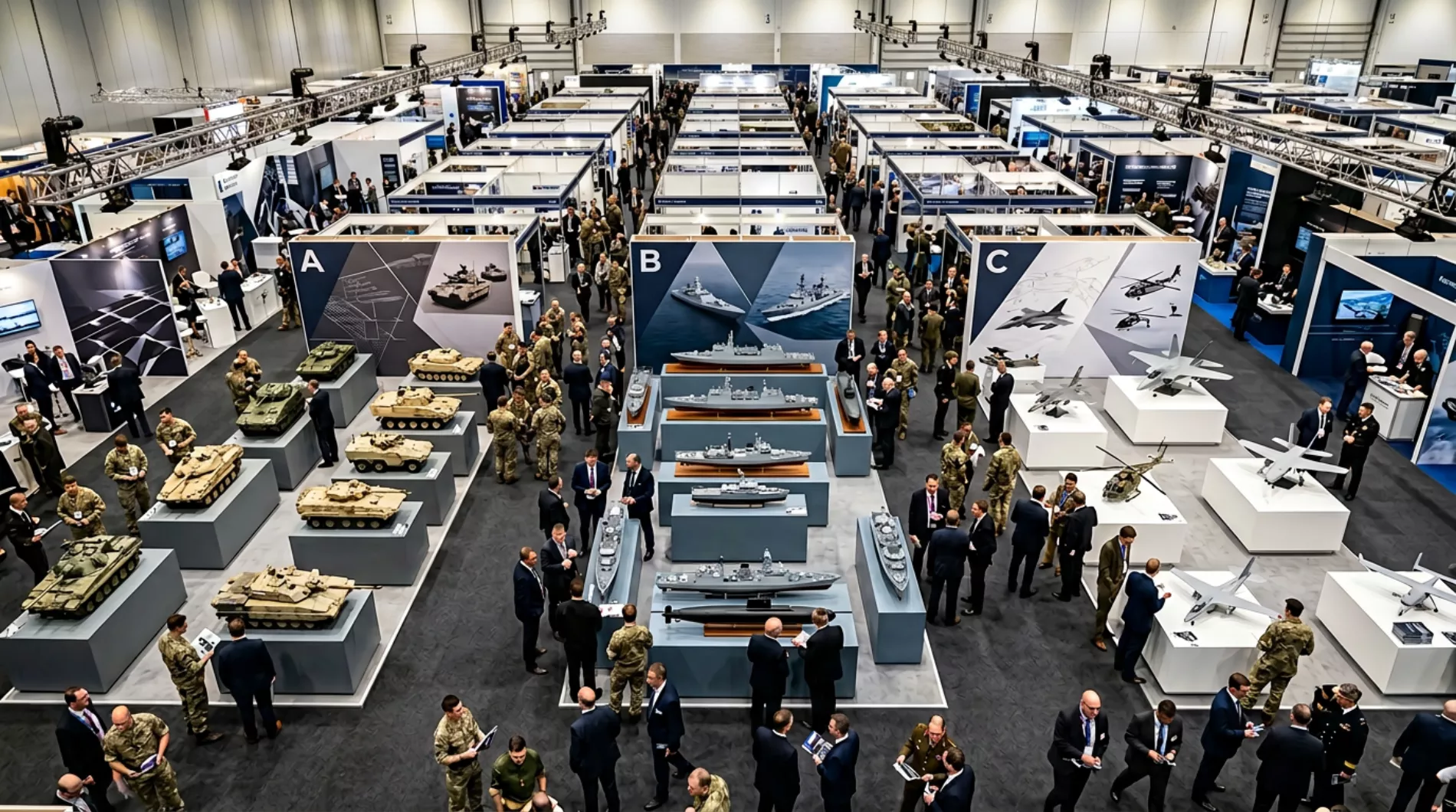
What Scale and Fidelity Are Required for an Effective Defence Exhibition Model?
An effective defence exhibition model requires a scale typically between 1:48 and 1:72 for aircraft and vehicles — handheld to table-top size — with engineering fidelity matching professional display standards. Accurate external geometry, visible key subsystems, and materials durable enough for booth handling and repeated transport are baseline requirements.
Scale Selection Criteria
Scale selection depends on four primary factors: platform type, booth space, audience interaction distance and intended handling. For defence exhibitions at DSEI and Farnborough, the following general guidelines apply:
What Scale and Fidelity Are Required for an Effective Defence Exhibition Model?
An effective defence exhibition model requires a scale typically between 1:48 and 1:72 for aircraft and vehicles — handheld to table-top size — with engineering fidelity matching professional display standards. Accurate external geometry, visible key subsystems, and materials durable enough for booth handling and repeated transport are baseline requirements.
Scale Selection Criteria
Scale selection depends on four primary factors: platform type, booth space, audience interaction distance and intended handling. For defence exhibitions at DSEI and Farnborough, the following general guidelines apply:
Aircraft & Aerospace Systems
1:48 to 1:72 scale provides sufficient detail for subsystem visibility whilst remaining transportable. Larger scales (1:24 to 1:32) may suit single-platform feature displays.
Naval Vessels
1:100 to 1:350 scale, depending on vessel class and available display footprint. Frigate and destroyer models at 1:100 offer meaningful topside detail for system integration discussions.
Land Vehicles & Armoured Platforms
1:16 to 1:35 scale enables detailed representation of turret systems, protection packages and mobility configurations.
Defence Infrastructure & Base Layout
Variable scale dependent on site area, typically 1:200 to 1:500 for installation overviews.
Engineering Fidelity Standards
Fidelity refers to how accurately a model represents the actual platform’s geometry, proportions and subsystem layout. For defence exhibition contexts, fidelity requirements include:
Dimensional Accuracy
within agreed tolerances, verified using coordinate measuring machines (CMM) and laser scanning during production — a standard quality assurance approach aligned with ADS Group engineering standards and AS9100 aerospace quality management certification.
External Geometry Accuracy
reflecting current configuration, including antenna placements, sensor arrays and weapon system mounts.
Key Subsystem Visibility
payload bays, radar arrays, propulsion layouts — particularly where the model supports capability discussions with technically literate audiences.
Deliberate Extraction
of sensitive or classified detail, ensuring the model communicates capability without exposing restricted performance data.
Professional defence model commissioning requires clear specification of scale and fidelity requirements from the outset, including dimensional accuracy tolerances, functional requirements (static display versus operational demonstration), surface finish specifications and any special features such as cut-away sections or illuminated components.
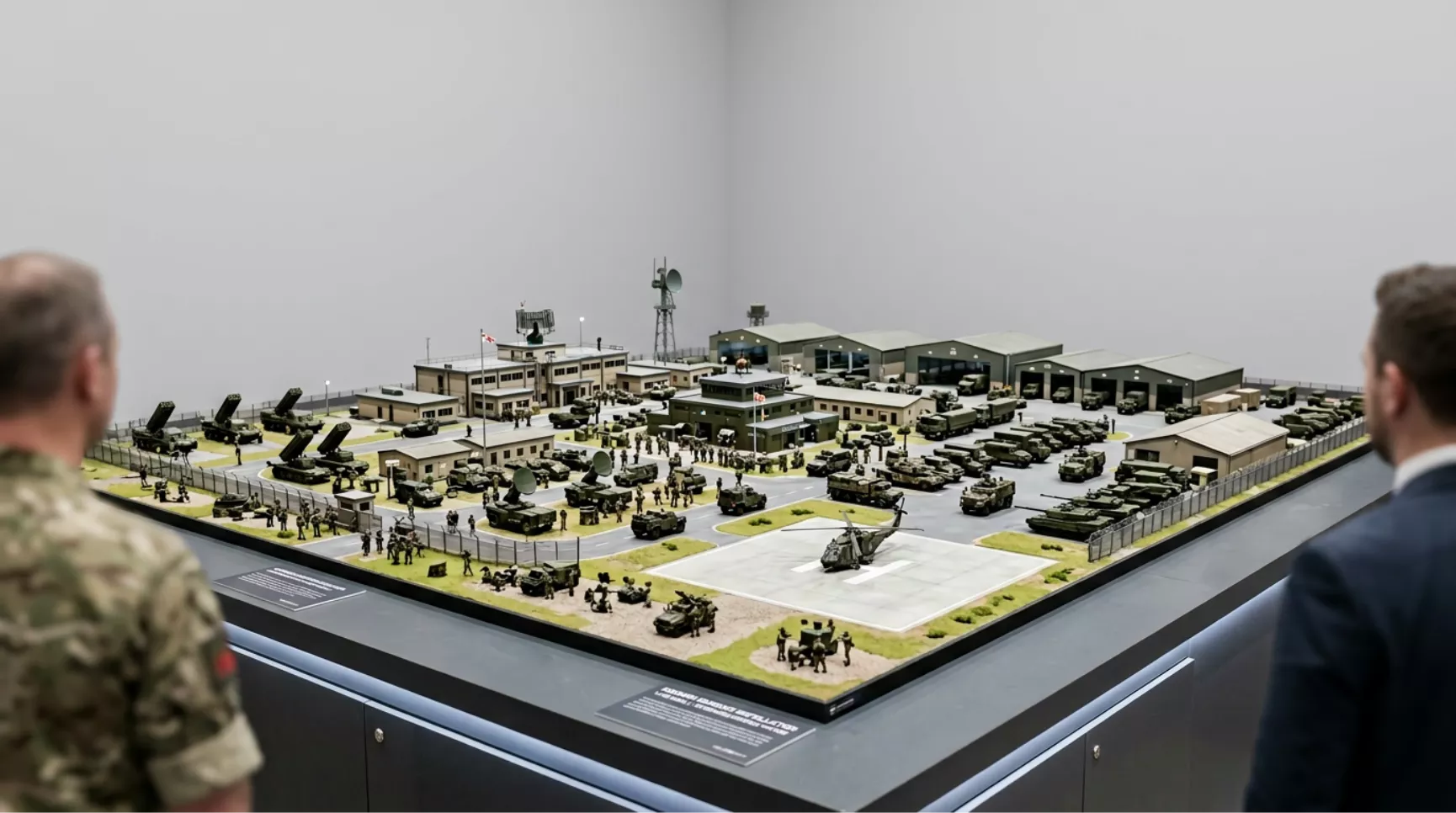
What Materials and Build Quality Define Effective Defence Exhibition Models?
Effective defence exhibition models are built from materials that combine visual quality with physical durability — robust enough to survive repeated transport, assembly and handling across multiple events whilst maintaining a professional finish that withstands close-range expert scrutiny.
Materials Engineering
Material selection for exhibition models follows strict compliance frameworks. Manufacturing processes must align with recognised quality management systems, ensuring rigorous quality control throughout production. Key material considerations include:
Structural Substrates
High-density polyurethane resins, engineering-grade ABS, aluminium alloys and glass-reinforced composites provide dimensional stability under varying exhibition hall temperatures.
Surface Finishes
Automotive-grade paint systems and specialist coatings deliver the visual standard expected at major defence exhibitions whilst resisting handling wear and UV exposure.
Component Fabrication
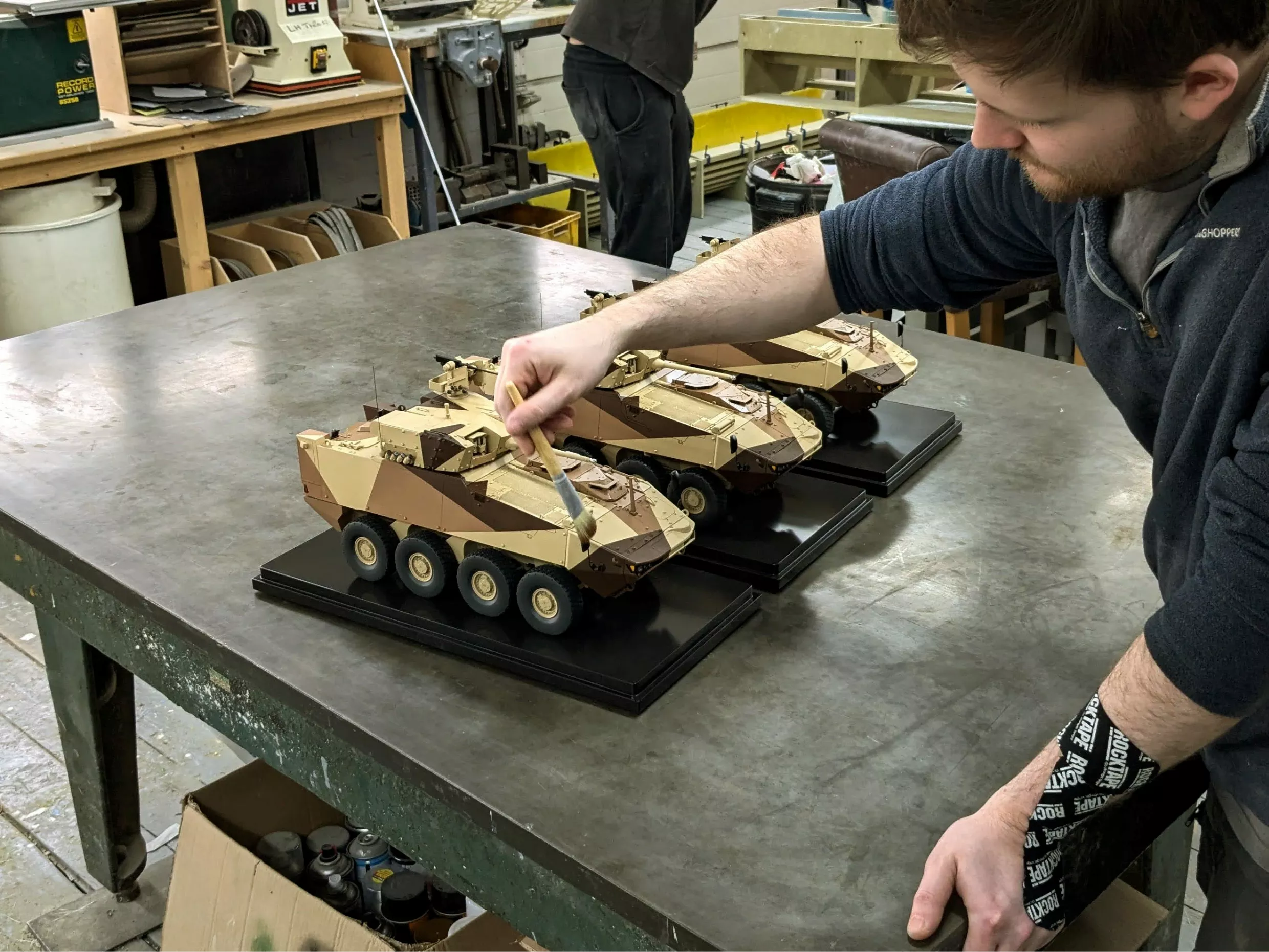
CNC machining for precision metal and plastic components, 3D printing (SLA/SLS) for complex geometries, and laser cutting for detailed flat components.
Durability Under Exhibition Conditions
Automotive-grade paint systems and specialist coatings deliver the visual standard expected at major defence exhibitions whilst resisting handling wear and UV exposure.
Manufacturing Technology
Modern defence exhibition model production combines traditional craftsmanship with advanced manufacturing technologies — a philosophy embedded across the UK defence supply chain. The ADS Group SC21 programme, which has supported over 1,000 SMEs in achieving recognised supply chain performance standards, underlines the importance of manufacturing excellence, quality and delivery reliability across the aerospace and defence sectors.
Production methods for effective defence exhibition models typically include:
CAD/ CAM Systems
for precise digital modelling from technical drawings and source data.
Multi-axis CNC Machining
for exceptional dimensional accuracy on structural and detail components.
Additive Manufacturing
for rapid prototyping, complex geometries and small-batch detail parts.
Traditional Hand Finishing
by skilled craftspeople for final assembly, paint application and weathering effects that add visual credibility.
How Should an Effective Defence Exhibition Model Support Stakeholder Communications?
An effective defence exhibition model functions as a communications tool that facilitates structured engagement between exhibitors and decision-makers — not merely a visual centrepiece. It anchors discussion, reduces ambiguity and provides shared spatial understanding that digital presentations alone cannot consistently achieve.
Communications Function
Defence trade shows operate as structured business environments. At DSEI 2025, 81% of visitors reported having successful meetings with exhibitors, and 80% attended specifically to meet and do business. Physical models serve a distinct role in these engagements:
Anchoring Technical Discussions
Models provide a shared reference point when explaining system architecture, integration challenges and spatial constraints to mixed audiences of engineers, procurement officers and military end users.
Capability Communication
For competitive bids and programme briefings, a well-specified model communicates capability clearly and consistently without relying on attendees having access to specialist software or digital infrastructure.
Cross-discipline understanding
RUSI has consistently highlighted the need for clear communication across procurement, operational and industrial stakeholders in UK defence. Physical models bridge the gap between technical documentation and intuitive
Audience-Specific Design Criteria
Model design should reflect the expected audience profile. Defence communications teams should consider:
Senior Military & Government Delegations
Models supporting high-level capability briefings prioritise clean presentation, strategic context (e.g. operational environment dioramas) and rapid comprehension over granular technical detail.
Engineering & Integration Teams
Models for technical engagement require higher subsystem fidelity, sectional views and potentially removable components for access demonstration.
Procurement & Programme Leads
Models supporting competitive evaluations must be accurate, professionally presented and clearly referenced to programme specifications.
International Delegations
At events like DSEI and Farnborough, where exhibitors engage delegations from 50+ nations, models must be self-explanatory, with clear labelling and visual hierarchy.
What Transport, Logistics and Durability Standards Apply to Effective Defence Exhibition Models?
An effective defence exhibition model must be designed for repeated transport, rapid assembly and reliable performance across multiple exhibition deployments — typically two to four major events per year plus additional customer briefings. Transport durability is a non-negotiable engineering criterion.
Transport Engineering
Exhibition models face significant mechanical stresses during transport and set-up. Engineering considerations include:
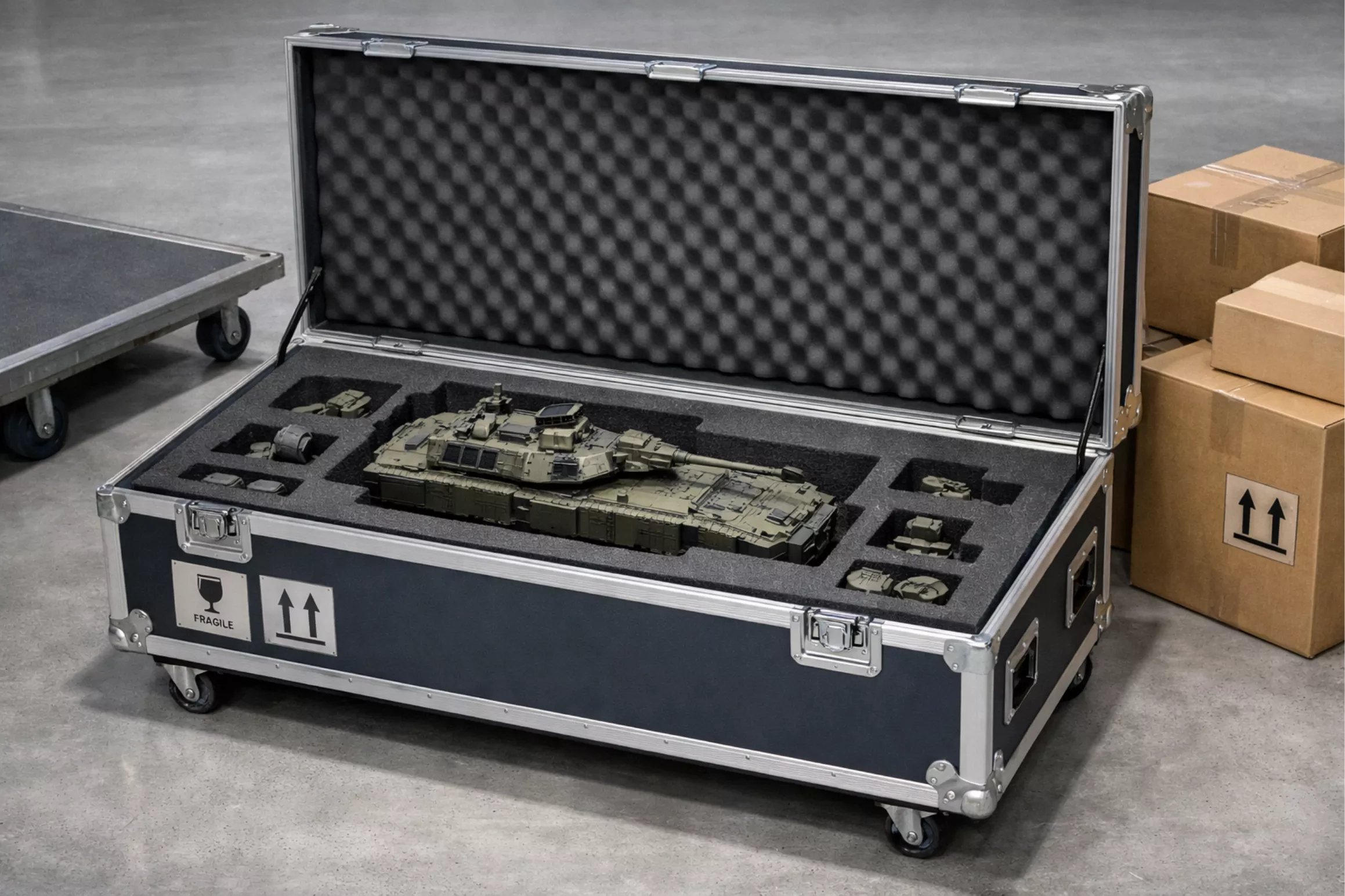
Custom Transit Cases
Foam-lined, flight-rated cases with shock absorption designed specifically for the model’s geometry. Military-grade transit case standards provide a useful benchmark for protection levels.
Modular Construction
Larger models benefit from designed break-points allowing safe disassembly for transport and rapid reassembly on-site, with registration features ensuring precise re-alignment.
Environmental Resilience
Exhibition halls present variable temperature and humidity conditions. Materials and adhesives must accommodate these ranges without warping, cracking or finish discolouration.
Vibration & Impact Resistance
Models must withstand road and air transport vibration profiles without finish degradation, component detachment or structural fatigue.
Exhibition-Specific Safety Requirements
Farnborough International Airshow exhibition regulations and DSEI exhibitor guidelines require exhibitors to ensure that displays with moving parts are securely fixed or safeguarded, and that all stand activities and demonstrations are covered by appropriate risk assessments. This applies equally to static models where components may detach during public interaction, illuminated features requiring electrical safety compliance, and any interactive or mechanical elements.
How Is an Effective Defence Exhibition Model Aligned with ADS Group Supply Chain Standards?
An effective defence exhibition model should be produced by a supplier aligned with the quality, delivery and continuous improvement principles embedded in the ADS Group Supply Chain Solutions (SCS) Framework — the recognised standard for aerospace and defence supply chain performance in the UK.
ADS Group Standards Context
The ADS Group’s SC21 Competitiveness Programme, built on over 18 years of success, focuses on improving competitiveness across the aerospace and defence sectors through supply chain performance, quality improvement and continuous improvement disciplines. It optimises the customer-supplier relationship for mutual benefit and is supported by leading primes and OEMs.
For defence exhibition model procurement, the principles translate to:
- Quality management: Production processes governed by documented quality management systems, with material traceability, in-process inspection and pre-delivery acceptance testing.
- Delivery reliability: Consistent on-time delivery against agreed milestones, critical when exhibition dates are fixed and non-negotiable.
- Continuous improvement: A supplier culture of ongoing process refinement, technology investment and capability development.
Defence-Specific Governance
Beyond general supply chain standards, defence model suppliers must demonstrate:
- Security and confidentiality: Controlled access production areas, encrypted communications, strict data handling procedures and compartmentalised operations — essential when working with sensitive platform data and configurations.
- Personnel vetting: Background checks and, where required, Security Check (SC) or Developed Vetting (DV) clearance aligned with project classification levels.
- IP protection: Secure data transmission protocols, restricted access manufacturing facilities and comprehensive non-disclosure agreements.
- Documentation and traceability: Comprehensive quality records, test certificates and compliance statements supporting formal acceptance processes.
How Do You Measure the Effectiveness of a Defence Exhibition Model?
Effectiveness is measured through three domains: technical accuracy verified against source specifications, communications impact assessed through stakeholder engagement quality, and operational resilience demonstrated through multi-event deployment without degradation.
Technical Accuracy Metrics
- Dimensional compliance against specified tolerances (verified by CMM/laser scanning).
- Geometric accuracy of external profile and subsystem representations.
- Surface finish quality assessed against agreed visual standards.
- Configuration accuracy reflecting current programme baseline.
Communications Impact Metrics
Defence exhibition ROI is increasingly measured not by foot traffic volume but by meeting density and engagement quality. Companies adopting structured exhibition strategies report higher meeting density, more senior-level interactions and more structured follow-up pipelines.
Key communications metrics for exhibition model effectiveness include:
- Number of structured stakeholder briefings supported by the model.
- Quality of technical discussions facilitated (measured through post-event stakeholder feedback).
- Consistency of messaging across multiple presenters using the model as a visual anchor.
- Model re-use across multiple events, customer briefings and internal reviews, demonstrating return on investment.
Operational Resilience Metrics
- Number of event deployments without requiring significant repair or refinishing.
- Transport cycle survival rate (percentage of deployments without handling damage).
- Set-up and break-down time on exhibition stand.
- Long-term condition maintenance over the model’s service life.
What Makes Defence Exhibition Models Effective at DSEI and Farnborough Specifically?
Effective defence exhibition models for DSEI and Farnborough must account for the specific characteristics of each event — visitor volume, engagement format, stand density and delegation profiles — as well as the practical logistics of multi-day exhibition operation.
DSEI Context
DSEI is the world’s largest integrated defence and security exhibition, with the 2025 edition drawing over 60,000 visitors and 1,700 exhibitors from 50 nations. Key considerations for effective defence exhibition models at DSEI include:
- High visitor density requiring models robust enough for close-range viewing by thousands of attendees over four days.
- Multi-domain coverage (land, air, naval, security, joint) — models must communicate capability within specific domain zones.
- SME visibility — with 42% of DSEI 2025 exhibitors being first-time participants, many SMEs, an effective model can be a critical differentiator on smaller stands.
- ADS Pavilion presence — exhibitors within the ADS-coordinated UK Pavilion benefit from structured engagement opportunities that models directly support.
Farnborough Context
Farnborough International Airshow combines trade exhibition with flying displays and public engagement, attracting over 100,000 visitors and generating substantial commercial activity. Effective defence exhibition models for Farnborough require:
- Dual-audience readiness — models must support both trade professional briefings and, where applicable, public-facing engagement during Pioneers of Tomorrow and public days.
- Extended environmental exposure — five-day events in exhibition halls and potentially outdoor chalet environments require enhanced UV and environmental protection.
- Aerospace emphasis — models of aircraft, UAV and missile systems benefit from higher fidelity and larger scales given the aerospace-focused audience.
How Should You Commission an Effective Defence Exhibition Model?
Commissioning an effective defence exhibition model requires early engagement with a specialist manufacturer who understands MOD environments, defence governance requirements and the specific demands of exhibition deployment. A structured brief covering technical specifications, audience requirements, logistics and security is essential.
Commissioning Best Practice
Based on established defence model commissioning protocols:
- Define the requirement clearly: Specify intended application (exhibition, procurement, training), target audience, platform configuration baseline, scale, fidelity level, and any features such as cut-away sections, illuminated components or modular elements.
- Establish security parameters: Determine data classification levels, personnel vetting requirements and what can and cannot be represented physically.
- Set quality and standards requirements: Specify whether AS9100, Def Stan or other compliance frameworks apply, along with dimensional accuracy tolerances and materials requirements.
- Plan for logistics: Include transport case specification, assembly/disassembly requirements, and exhibition venue constraints in the original brief.
- Agree milestones: Design review and approval, material procurement, manufacturing progress reviews, pre-delivery inspection and final acceptance.
Choosing a Specialist Partner
The UK defence supply chain values proven capability and long-term relationships. Key criteria for selecting a defence exhibition model partner include:
- Demonstrated defence and aerospace sector experience.
- Secure handling of sensitive information and established security infrastructure.
- Understanding of MOD procurement and engagement contexts.
- Complete UK-based in-house production capability, eliminating external security risks.
- Comprehensive quality assurance and documentation.
For specialist guidance on commissioning effective defence exhibition models, contact Defence Models UK — the UK’s specialist manufacturer with over 60 years’ experience supporting MOD, DE&S and defence contractors.
What scale is best for a defence exhibition model at DSEI or Farnborough?
Scale depends on platform type and display context. Aircraft typically work well at 1:48 to 1:72 scale for table-top display; naval vessels suit 1:100 to 1:350; land vehicles 1:16 to 1:35. The key criterion is sufficient detail for technical discussion whilst remaining transportable and appropriate for booth space.
How durable does a defence exhibition model need to be?
Exhibition models should withstand a minimum of two to four major event deployments per year, plus additional customer briefings. This means engineering-grade materials, automotive-quality paint finishes, custom transit cases and modular construction designed for repeated transport and assembly.
What quality standards apply to defence exhibition models?
Quality management aligned with AS9100 aerospace standards provides the benchmark, including material traceability, dimensional verification, in-process inspection and formal acceptance testing. ADS Group SC21 supply chain principles of quality, delivery and continuous improvement are directly applicable.
How do physical models compare to digital displays at defence exhibitions?
Physical models complement digital tools rather than competing with them. They provide shared spatial understanding, anchor multi-stakeholder discussions without requiring specialist software access, and function reliably regardless of venue IT infrastructure. The most effective exhibition strategies use both.
What security considerations apply when commissioning defence exhibition models?
Models are designed to communicate capability without exposing sensitive performance data. Security management includes controlled data handling, personnel vetting aligned with classification levels, secure manufacturing facilities, IP protection and clear agreement on what detail is included or deliberately abstracted.
How far in advance should a defence exhibition model be commissioned?
Lead times vary by complexity. Standard exhibition models typically require 8–12 weeks from brief approval; complex or multi-configuration models may need 16–24 weeks. Early engagement allows optimum design development and avoids compressed timelines that may compromise quality.
About the Author
Defence Models UK is the UK-based specialist manufacturer of defence, aerospace and government presentation, display and training models, with over 60 years’ experience supporting MOD, DE&S and defence contractors. DMUK delivers precision-engineered effective defence exhibition models meeting ADS Group standards for exhibitions, strategic planning, procurement and training, maintaining defence-grade confidentiality, technical accuracy and professional presentation standards.
Sources
- ADS Group — https://www.adsgroup.org.uk/ — UK trade association for aerospace, defence, security and space. Primary authority on supply chain standards, SC21 programme and exhibition coordination. Credibility: Government-recognised industry body.
- ADS Group Engineering Standards Committee — https://www.adsgroup.org.uk/services/groups-committees/engineering-standards-committee/ — Promotes standardisation across UK aerospace and defence. Credibility: Formal interface between industry and international standards bodies.
- ADS Group SC21 / SCS Framework — https://www.adsgroup.org.uk/knowledge/ads-celebrates-2024-cqi-international-outstanding-achievement-award-for-its-sc21-competitiveness-programme/ — CQI award-winning supply chain quality programme. Credibility: 18+ years, 1,000+ SMEs supported.
- The Engineer — https://www.theengineer.co.uk/ — Leading UK engineering publication covering defence manufacturing, technology and analysis. Credibility: Established technical journalism.
- DSEI — https://www.dsei.co.uk/ — World’s largest integrated defence and security exhibition. Credibility: Official event source for attendance and exhibitor data.
- Farnborough International Airshow — https://www.farnboroughinternational.org/ — Premier global aerospace and defence trade event. Credibility: Official event source.
- RUSI — https://www.rusi.org/ — Royal United Services Institute for Defence and Security Studies. Credibility: Leading independent defence think tank.
- Defence Models UK — https://defencemodels.co.uk/about-dmuk/ — 60+ years specialist defence model production. Credibility: Established MOD/DE&S supplier.
Related Articles
- How Scale and Replica Models Are Used Across UK Defence — Pillar article covering the full scope of defence model applications.
- Article 1: Defence Model Procurement — How models support structured MOD procurement processes.
- Article 2: Physical vs Digital Defence Models — Where physical models complement digital tools.
- Article 3: Defence Models at DSEI and Farnborough — Event-specific strategies for major UK exhibitions.
#EffectiveDefenceModels #DefenceExhibitionModel #DSEI #Farnborough #ADSGroup #DefenceExhibitions #DefenceTradeShow #UKDefence #DefenceCommunications #ExhibitionModelCriteria #DefenceModelStandards #MilitaryModels #DefenceEngineering #StakeholderEngagement #CapabilityCommunication #DefenceSupplyChain #SC21 #DefenceProcurement #DefenceModelsUK #PrecisionEngineering