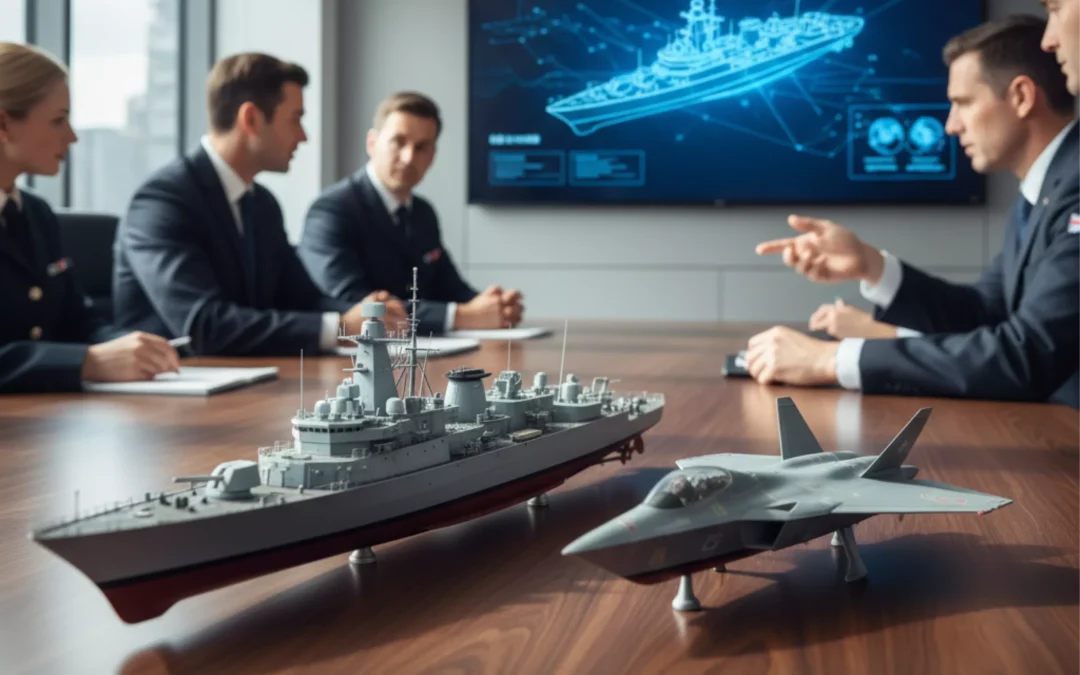
Physical defence models remain essential tools for UK defence primes and innovation teams, even as digital twins, VR and simulation reshape capability development. Far from being legacy artefacts, physical defence models serve a distinct and complementary role within the modelling and simulation (M&S) ecosystem — bridging the gap between abstract digital data and the tangible, collaborative understanding that complex defence programmes demand. This article examines why organisations aligned with DSTL and RUSI discourse on systems thinking continue to invest in physical defence modelling capabilities alongside digital transformation.[1][2]
Why do physical defence models still matter when digital twins exist?
Physical defence models matter because they deliver immediate spatial comprehension, cross-discipline accessibility and tactile engagement that digital twins alone cannot replicate. Digital twin technology has transformed defence capability development — enabling real-time monitoring, predictive maintenance and simulation of military platforms across land, sea and air. Yet digital twins operate within screens and require technical literacy, specialist software and secure computing infrastructure to interpret effectively.[3]
Physical scale models, by contrast, provide an immediate, shared reference point. When a systems integration lead, a military end user, a human factors specialist and a commercial manager stand around the same model, they are engaging with a common physical object that requires no software training, no login credentials and no screen interpretation. This matters in defence procurement environments where decisions involve participants from vastly different technical backgrounds.[4]
Research into digital twins in defence confirms that while virtual replicas excel at data-driven analysis and scenario simulation, challenges remain around standardisation, interoperability and cross-domain applicability. A 2025 academic review of digital twins in defence highlighted the need for “robust frameworks and interdisciplinary collaborations” to realise their full potential — precisely the kind of collaborative clarity that tangible physical defence models support in practice.[5]
The argument is not physical versus digital. It is physical and digital — each tool serving distinct functions within an integrated capability development process.
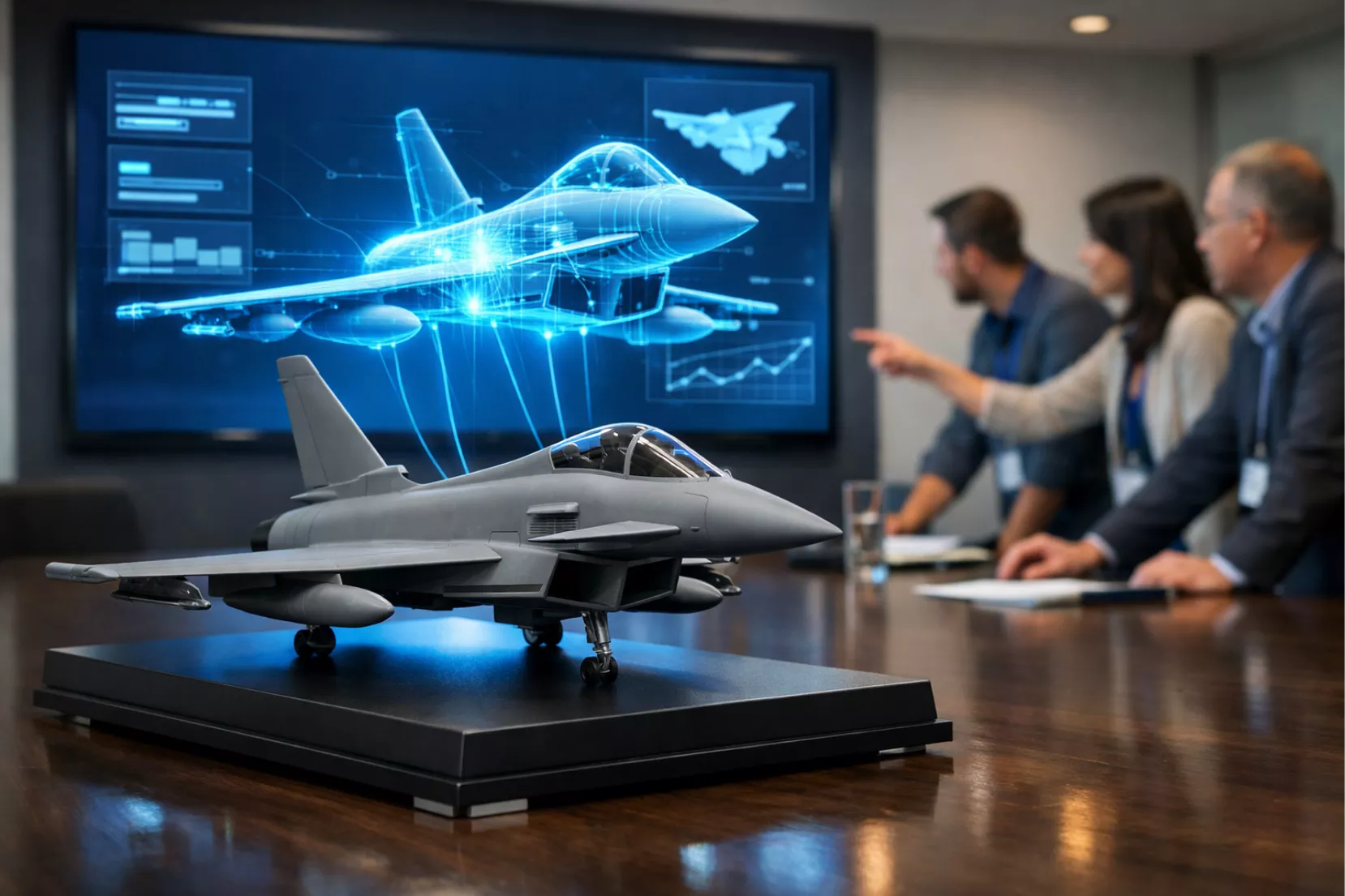
How do physical defence models complement DSTL’s systems thinking approach?
Physical defence models complement DSTL’s systems thinking approach by making complex system interdependencies visible and accessible to diverse stakeholder groups in ways that support challenge, discussion and shared understanding.
DSTL’s Exploration Division draws on expertise in “horizon scanning, systems thinking, wargaming, simulation, social science and operational research” to identify and accelerate transformative capabilities for UK defence. Central to this approach is creating what DSTL describes as a “safe space in which to challenge accepted plans” — an environment where assumptions can be tested and novel concepts explored before committing resources to development.[6]
Physical defence models directly support this philosophy. A scale representation of a naval vessel’s topside arrangement, for example, allows engineers, operators and analysts to identify spatial conflicts, integration challenges and human factors considerations in a single session. These are the kinds of interdependencies that systems thinking seeks to surface — and that are often more intuitively grasped through three-dimensional physical examination than through 2D screen-based review.[1]
DSTL’s work in modelling and simulation spans physics-based simulation through to campaign analysis. Their approach explicitly values the combination of computational modelling with human-centred methods such as wargaming — where manual and physical approaches complement computer-based tools to support decision-making and behavioural analysis. Physical defence models fit naturally within this blended methodology, providing the tangible anchor that connects abstract systems models to real-world engineering constraints.[7][8]
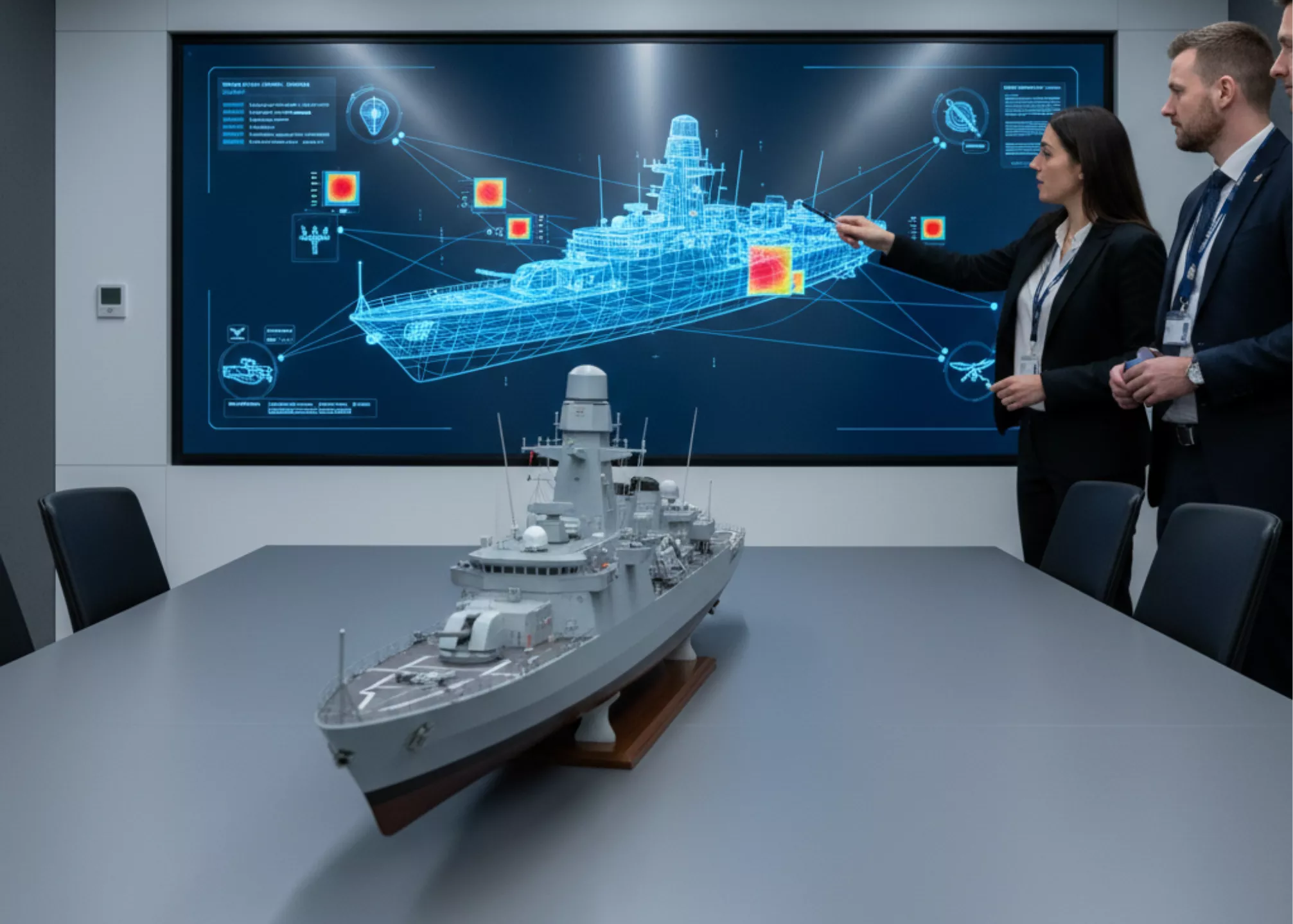
Where do physical defence models outperform purely digital solutions?
Physical scale models for defence outperform purely digital solutions in scenarios requiring immediate spatial understanding, multi-stakeholder engagement, environments without secure digital infrastructure, and contexts where cognitive accessibility matters.
Spatial comprehension and integration review
Complex defence platforms — whether a Type 26 frigate, an armoured vehicle variant or an airfield infrastructure layout — involve thousands of interdependent spatial relationships. While CAD models and digital twins capture these relationships mathematically, a physical scale model presents them simultaneously and intuitively. Decision-makers can walk around the model, point to specific areas, and discuss trade-offs without navigating software menus or waiting for rendering.[4]
Cross-discipline collaboration
Defence programmes bring together military operators, engineers, procurement specialists, human factors experts and political stakeholders. Not all participants share the same technical vocabulary or software fluency. Physical models in defence provide a universal communication medium — a shared object that levels the playing field and encourages contribution from all disciplines.[9]
Environments without secure digital access
Briefing rooms, parliamentary offices, exhibition stands and deployed operational environments do not always support the classified computing infrastructure that digital twins require. Physical models travel where screens cannot, providing accurate three-dimensional representation without cybersecurity risk or IT dependency.[2]
Cognitive load and human factors
Research into cognitive load in defence contexts confirms that the increasing complexity of digital data can lead to cognitive overload among personnel. Tangible scale models reduce this burden by presenting spatial information in a format that the human visual and haptic systems process naturally — without the intermediary layer of software interpretation.[10]

How do RUSI insights support balanced physical and digital approaches?
RUSI’s research consistently emphasises that effective defence capability depends not on individual technologies but on the ability to integrate, test and scale credible solutions — a principle that supports the continued role of physical models within broader digital transformation.[11]
RUSI’s work on prototype warfare and capability integration underscores a recurring theme: defence innovation succeeds through integration of methods rather than wholesale replacement of one approach by another. Their analysis of the Global Combat Air Programme (GCAP), for instance, highlights how digital engineering dramatically accelerates development — with simulation-to-design cycles that once took months now achievable overnight. Yet the same analysis acknowledges the critical importance of real-world testing and physical validation alongside digital tools.[12][13]
RUSI’s commentary on defence innovation further notes the need to accelerate transition from concept to operational capability. Physical models serve this transition by providing early-stage tangible representations that allow military end users to engage with proposed solutions before committing to costly development. This aligns with RUSI’s emphasis on rapid prototyping and the importance of setting clear parameters for transitioning from prototype to production.[14][13]
The broader RUSI discourse on UK defence technology is instructive: while acknowledging that “policymakers and practitioners are betting on a military that forgoes massed warfighting in favour of smaller-scale, digitally-enabled physical and information manoeuvre,” RUSI analysts also question whether technology alone can solve the military’s challenges. Physical scale models provide a low-risk, high-clarity complement to digital ambition.[15]
When should innovation teams combine physical defence models with VR and AR?
Innovation teams should combine physical defence models with VR and AR in defence when programmes require both immersive digital simulation and accessible physical reference — particularly during concept development, design review and stakeholder engagement phases.
The most effective defence innovation workflows are not exclusively digital or physical. They are hybrid. Consider a capability development programme for a new armoured vehicle variant:
- Concept phase: A physical scale model allows military users, engineers and procurement leads to establish shared understanding of the platform’s form, scale and key integration points during early workshops.[1]
- Design development: Digital twins and CAD models enable rapid iteration, parametric analysis and virtual testing of structural, thermal and electromagnetic performance.[3]
- Design review: The scale model returns as a reference object during milestone reviews, ensuring that digital changes are understood in spatial context by non-specialist reviewers.
- Stakeholder briefing: VR and AR allow immersive walkthroughs for senior decision-makers, while the physical model provides a persistent, always-accessible reference in briefing rooms and exhibition environments.[2]
Extended reality (XR) integration with digital twins is a growing area, with defence research confirming that XR is “exceptionally well suited for integration with digital twins” for training, mission planning and remote assistance. Physical scale models anchor this ecosystem by providing the initial tangible framework from which digital representations are developed and against which they are validated.[3]
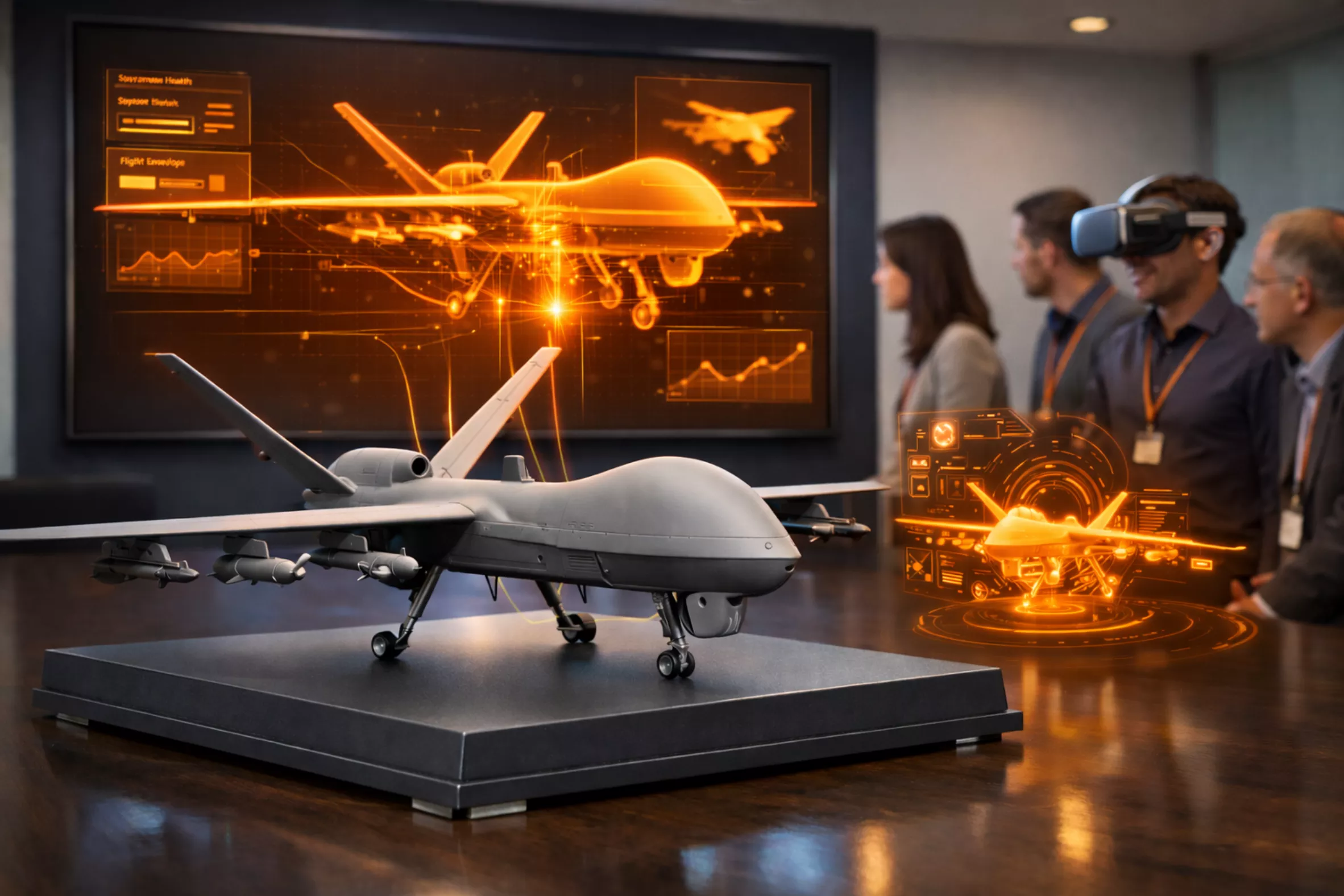
How do physical models improve cross-discipline collaboration in defence?
Physical models in defence improve cross-discipline collaboration by providing a shared, technology-neutral reference point that enables productive engagement across engineering, military, commercial and political stakeholder groups.
Defence programmes at prime contractor and MOD level involve participants whose expertise spans mechanical engineering, systems integration, human factors, logistics, commercial strategy and military operations. Each discipline has its own tools, terminology and cognitive frameworks. Digital tools — however powerful — tend to serve specific disciplines most effectively. A finite element analysis model serves the structural engineer; a logistics simulation serves the supply chain analyst; a digital twin serves the platform manager.[16]
Scale models serve everyone simultaneously. They create what DSTL’s approach would recognise as a “boundary object” — a shared artefact that facilitates communication across disciplines without requiring participants to adopt unfamiliar tools or vocabulary. When QinetiQ describes its modelling and simulation work for DSTL, the emphasis falls on reducing complexity and enabling broader participation in analysis — goals that physical models support inherently.[17]
This collaborative function is particularly valuable during the Integrated Procurement Model’s emphasis on shared capability portfolios, where diverse teams must align on cross-service solutions. Physical defence models provide the common ground on which these conversations become productive.[18]
What role do physical defence models play in the innovation pipeline?
Physical models serve as clarity tools at critical decision points in the UK defence innovation pipeline — from early concept exploration through to production readiness review and parliamentary scrutiny.
The UK’s defence innovation ecosystem, shaped by organisations including DSTL, RUSI, DE&S and the recently established UK Defence Innovation function, is designed to accelerate the transition of novel technologies into operational capability. Physical models support this pipeline at multiple stages:[14]
- Exploration and concept: Scale models help innovation teams visualise proposed solutions during early-stage evaluation, supporting DSTL’s wargaming and concept development activities.[6]
- Procurement and business case: Tangible models support investment approval briefings by making complex capability proposals accessible for non-technical decision-makers — a critical requirement given the NAO’s persistent concerns about the performance of major equipment contracts.[19]
- Design and integration: Alongside digital twins, physical scale models provide spatial validation during systems integration review.[20]
- Engagement and export: At defence exhibitions, parliamentary briefings and allied nation engagements, physical models communicate capability without requiring classified digital infrastructure.[21]
With the MOD’s Equipment Plan covering more than 1,800 projects and a budget of £288.6 billion over the decade to 2033, the stakes for clear communication and effective risk management at every stage are significant. Physical defence models contribute to both.[22]
Choosing the right partner for physical defence models
Selecting a specialist partner for physical defence models requires proven defence sector experience, secure handling of sensitive information and an understanding of how physical defence models integrate within broader digital and procurement workflows.
Defence Models UK combines traditional craftsmanship with modern manufacturing to deliver precision physical defence models that complement digital transformation programmes. With over 60 years supporting MOD, defence primes and research establishments, DMUK understands the specific requirements of defence innovation teams — from security protocols and technical accuracy to programme-aware delivery timelines.[23][4]
For organisations seeking to understand how physical defence models fit within wider defence capability development, the pillar guide to how scale and replica models are used in UK defence provides comprehensive context. For procurement-specific applications, the article on how scale models are used in UK defence procurement examines the practical role models play within DE&S acquisition frameworks.[1]
Frequently asked questions
Why are physical defence models still relevant in a digital-first industry?
Physical defence models remain relevant because they provide immediate spatial comprehension, cross-discipline accessibility and tangible engagement that digital tools alone cannot deliver. They complement digital twins and VR by offering a shared, technology-neutral reference point for complex defence programmes.[3][1]
How do physical defence models complement digital twins in defence?
Physical defence models and digital twins serve different but complementary functions. Digital twins excel at data-driven simulation, predictive analysis and parametric testing. Physical defence models provide intuitive spatial understanding, support multi-stakeholder collaboration and function in environments where secure digital infrastructure is unavailable.[5][4]
What does DSTL say about combining physical and digital approaches?
DSTL’s approach to modelling and simulation values the combination of computational tools with human-centred methods including wargaming and physical modelling. Their Exploration Division explicitly draws on systems thinking and simulation alongside operational research to accelerate transformative capabilities.[8][6]
When should defence, primes use physical defence models alongside VR and AR?
Defence primes should use physical defence models alongside VR and AR during concept development, design review milestones, stakeholder briefings and exhibition engagements — any context where immediate, universal accessibility and tangible spatial reference add value beyond screen-based presentation.[3]
How do physical defence models reduce programme risk in defence?
Physical defence models reduce programme risk by surfacing spatial conflicts, integration challenges and human factors considerations early in the development lifecycle. They support clear communication during investment approval and design review, reducing the likelihood of costly late-stage changes.[24][19]
How does Defence Models UK support innovation teams?
Defence Models UK delivers precision-engineered physical defence models that integrate within broader digital transformation and capability development workflows. With 60+ years of defence sector experience and comprehensive security protocols, DMUK serves MOD, primes and research establishments across all domains.[23][2]
Sources
- DSTL (Defence Science and Technology Laboratory) — UK government agency delivering science and technology advantage for defence and security. Systems thinking, modelling and simulation expertise. https://www.dstl.gov.uk/
- DSTL Exploration Division — Identifies and accelerates transformative technologies using horizon scanning, systems thinking, wargaming and simulation. https://www.gov.uk/government/news/dstl-unveils-new-exploration-division
- DSTL Wargaming and Behavioural Effects — Combines physical and digital wargaming methods to support defence decision-making. https://www.gov.uk/government/news/dstl-wargames-the-power-of-influence
- RUSI (Royal United Services Institute) — Independent defence and security think tank providing research and commentary on capability integration, procurement reform and digital transformation. https://www.rusi.org/
- RUSI — Five Innovations in Defence Procurement (GCAP) — Analysis of digital engineering, spiral development and prototype-to-production transition. https://www.rusi.org/explore-our-research/publications/commentary/five-innovations-make-defence-procurement-faster-and-cut-cost-overruns
- RUSI — Can Technology Solve the UK Military’s Problems? — Examines the balance between digital ambition and practical defence capability. https://www.rusi.org/explore-our-research/publications/commentary/can-technology-solve-uk-militarys-problems
- RUSI — Launching UK Defence Innovation — Commentary on accelerating defence innovation and prototype warfare. https://www.rusi.org/explore-our-research/publications/commentary/same-same-different-launching-uk-defence-innovation
- NAO — Improving the Performance of Major Equipment Contracts — Examines persistent delays and cost increases in MOD equipment contracts. https://www.nao.org.uk/reports/improving-the-performance-of-major-equipment-contracts/
- NAO — The Equipment Plan 2023 to 2033 — Analysis of MOD equipment spending and affordability challenges. https://www.nao.org.uk/reports/equipment-plan-2023-to-2033/
- DE&S (Defence Equipment and Support) — MOD arm’s length body managing defence procurement and equipment support. https://www.gov.uk/government/organisations/defence-equipment-and-support
- QinetiQ — Modelling and Simulation — M&S lead for DSTL’s ASTRID programme, combining computational and analytical approaches. https://www.qinetiq.com/en/what-we-do/services-and-products/modelling-and-simulation
- Team Defence Information — Digital Twins — Vision for federated digital twins supporting multi-domain integration. https://www.teamdefence.info/digital-twin/
- Defence Models UK — Specialist UK defence model maker with 60+ years’ experience supporting MOD, primes and innovation teams. https://defencemodels.co.uk
References
- Scale and replica models in the UK defence industry – Discover how scale and replica models in the UK support UK defence procurement, training and stakeho…
- HOME – DEFENCE MODELS UK – Precision Defence Scale Models for UK Military & Aerospace. The UK Based Dedicated Defence Modelling…
- On Digital Twins in Defence: Overview and Applications – arXiv.org
- CAPABILITIES – DEFENCE MODELS UK – For over six decades, we have been the trusted partner for defence organisations, military establish…
- On Digital Twins in Defence: Overview and Applications – Digital twin technology has gained increasing attention across various sectors due to its ability to…
- Dstl unveils new Exploration Division – The new division will identify and accelerate transformative technologies, systems, concepts and str…
- Developments in Advanced, Physics-based Modelling and … – nafems – Dstl develops advanced modelling and simulation techniques to predict the effects of blast, ballisti…
- Dstl wargames the power of influence – GOV.UK – The event provided an opportunity for civil servants and military officers to experience wargames ba…
- About us – Defence Equipment and Support – As an arm’s length body of the Ministry of Defence, we deliver equipment and support services to the…
- 9 Studying cognitive load in defence – Introduction Cognitive load has a long association with human factors research into safety-critical …
- RUSI recommends prototype warfare for Royal Navy adaptability – Maritime defence innovation will be determined not by individual technologies alone but by the abili…
- Five Innovations that Make Defence Procurement Faster and Cut … – GCAP’s management involves five innovations that should drive success in its technology development …
- RUSI recommends prototype warfare for Royal Navy … – ADS is proud to be working with ADVANCE to produce its official industry magazine which is dedicated…
- Same, Same but Different? Launching UK Defence Innovation – RUSI – UK Defence Innovation wants to accelerate UK defence technology and capabilities and provide a strat…
- Can Technology Solve the UK Military’s Problems? – RUSI – Advances in AI, autonomy and data processes will theoretically make a leaner military that is faster…
- About DE&S – What we do. As an arm’s length body of the Ministry of Defence, we negotiate and manage defence cont…
- Modelling & Simulation
- Integrated Procurement Model: Driving pace in the delivery … – The Integrated Procurement Model is a fundamental shift in the way we acquire defence capability. It…
- Improving the performance of major equipment contracts – This report examines the causes of persistent delays and cost increases that have affected the Minis…
- Team Defence Information Digital Twins_PART 1.indd
- SERVICES – DEFENCE MODELS UK – Defence Models UK creates precision scale models for military, government and defence contractor cli…
- The Equipment Plan 2023 to 2033 – NAO report – The MoD acknowledges that its Equipment Plan for 2023–2033 is unaffordable, with forecast costs exce…
- ABOUT DMUK – DEFENCE MODELS UK – Defence Models UK represents over 60 years of established expertise in precision scale model product…
UK Ministry of Defence Completes Projects Within Time … – Project Risk Maturity Model incorporating @RISK has increased the number of projects delivered on
Authored by Defence Models UK
Defence Models UK combines traditional craftsmanship with modern manufacturing to deliver precision physical models for defence that complement digital transformation. With decades supporting UK defence primes and research establishments, DMUK understands how physical models enhance systems thinking alongside digital twins and simulation.
#PhysicalDefenceModels #DefenceInnovation #DigitalTwins #SystemsThinking #DSTL #RUSI #DefenceModelling #UKDefence #DefenceModelMaker #ModellingAndSimulation #DefenceProcurement #HumanFactors #DefenceDigitalTransformation #VRAR #ScaleModels #DefenceModelsUK #CapabilityDevelopment #DefencePrimes #MultiDomainIntegration #DefenceTechnology